Title
1. About the assessment
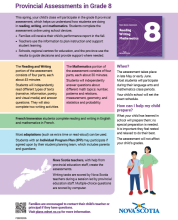
Grade 8 students participate in provincial assessments of reading, writing, and mathematics in May and June. The assessment results provide insight into how students are performing in relation to curriculum expectations in language arts and mathematics.
Nova Scotia teachers work with the Department of Education and Early Childhood Development (EECD) to develop these assessments. All items and texts on the assessment are based on the Nova Scotia curriculum. Teachers also help score student responses and set expectations. These expectations describe what students should know and be able to do independently at the time of the assessment.
New for 2025-26: Students will complete the assessment online using school devices instead of on paper. Although the assessment continues to reflect the same curriculum outcomes, the online format changes how students interact with it. As a result, this year’s results cannot be directly compared to previous years. Because of the change in format, teachers and department staff will set new expectations for measuring student performance. Starting next year, results will again be comparable, allowing trends to be tracked over time.
Who participates in the assessments?
- Students in English-language programs participate in Reading, Writing, and Mathematics in English.
- Students in French Immersion programs and the Conseil scolaire acadien provincial participate in Reading and Writing in English and Mathématiques in French.
- Students in the Conseil scolaire acadien provincial also participate in Lecture et écriture.
- A student with an Individual Program Plan (IPP) may participate if agreed upon by their student planning team, which includes parents and guardians.
How is the information from the assessments used?
- Families will receive their child’s performance report in the fall.

- Teachers use the results, alongside classroom assessment, to plan instruction and support student learning.
- Schools, regional centres for education, and the province use the results to inform decisions and provide support where needed.
- Results are not used to determine report card grades or grade level placement decisions.
Title
2. What to expect
The assessment is completed online at school using school devices and secure software. Most adaptations (such as extra time or read-aloud) can be used. If a student has an adaptation requiring a paper-based format (for example, Braille), a paper version will be provided.
The assessment is broken into parts that can fit into regular class periods. Students will complete no more than two parts in a day. Schools will choose the exact days within a 3-week window for students to complete all parts.
- The Reading and Writing portion of the assessment consists of four parts, each about 45 minutes. Students will read different types of texts (narrative, informational, poetry, and visual media) and answer questions about them.They will also complete two writing activities.
- The Mathematics portion of the assessment consists of four parts, each about 30 minutes. Students will answer questions about different math topics: number, patterns and relations, measurement, geometry, and statistics and probability.
Title
3. Sample assessments
To help students become comfortable with the online assessment format, they will complete short sample assessments in class. These samples allow students to become familiar with the online platform as well as the type and format of questions on the assessment.
These sample assessments are also available at the links below. These are the same samples used in class, so students do not need to complete them at home:
Students do not need to study or prepare in advance. The learning they have done throughout their years in school prepares them for the assessment.
Title
4. For families
Will the school send home any information about the assessment?
Schools will send home the Information Sheet for parents and families in the weeks before the assessment.
How can I help my child prepare?
What your child has learned in school will prepare them; no special preparation is needed. It is important they feel rested and relaxed to do their best. This assessment will not affect your child’s grades.
Will my child have access to the adaptations they use in class?
Most adaptations can be used during the assessment. For more information, talk to your child's teacher.
If my child has an Individual Program Plan (IPP) in language arts or mathematics, will they participate in the assessment?
A student with an Individual Program Plan may participate if agreed upon by their student planning team, which includes parents and guardians.
If my child is learning English as an Additional Language, will they participate in the assessment?
Students who are learning English will usually take the assessment. They can use a translator or a bilingual dictionary to translate a few words at a time, and can have extra time to finish. A student may be exempted from the assessment if the assessment is not suitable for their current English level.
How will I know how my child performed?
After the assessment is complete, the writing tasks are scored by Nova Scotia teachers during a session led by provincial education staff. Multiple-choice questions are scored by computer. Results are analyzed and an Individual Student Report is created for each student and will be available to families through PowerSchool. For more information about student reports, please see Information about Student Reports for Parents and Guardians
Title
5. For educators
Preparing for the assessment
Image

| Key Dates and Resources |
Image

| Overview Technical description with curriculum connections and types of questions |
Image

| Handbook |
Image

| User guides |
Image

| Alternate Formats |
Image

| Formula Sheet |
Image

| Sample Assessment Instructions for Teachers Reading and Writing, Mathematics and Mathématiques (GNSPES teacher login required) |
Interpreting results
Image

| Sample Student Reports |
Image

| Performance Levels |
Image

| Rubrics |
Image

| Curriculum Connections Lessons learned: Reading & Writing (paper-based) (GNSPES teacher login required) Lessons learned: Mathematics (paper-based) Mathematics: Cognitive Levels of Questions and Sample Questions Primary–Grade 12 |
Image

| Request for the Re-scoring of a Nova Scotia Assessment |